Continuous mode: deep heat
Gently heats tissue to relax muscle spasm, improve blood flow and make tight tendons and scar tissue more flexible before stretching.

Therapeutic ultrasound · North Beach, San Francisco
Therapeutic ultrasound, the kind used in physical therapy and chiropractic clinics, gently warms and loosens tight muscles, tendons and scar tissue to ease pain and support healing. For stubborn tendon pain, ask about our stronger option: focused shockwave therapy.
How it works
Ultrasound therapy is a treatment that uses high-frequency sound waves, delivered through a handheld wand and gel, to warm and stimulate soft tissue below the skin, increasing blood flow, relaxing muscles and supporting healing.
It is one of the most widely used tools in physical therapy and chiropractic care. You may hear it called therapeutic ultrasound, ultrasound massage or ultrasound treatment.
It is different from an ultrasound scan. Diagnostic ultrasound makes pictures of the body. Therapeutic ultrasound uses sound waves to treat it.
Gently heats tissue to relax muscle spasm, improve blood flow and make tight tendons and scar tissue more flexible before stretching.
Creates tiny vibrations with little heat, used to support healing in newer or more sensitive injuries.
We choose a lower frequency to reach deeper muscles and joints, or a higher frequency for tissue closer to the surface.
What it treats
Ultrasound works best on soft tissue that is tight, sore or slow to heal, as part of a plan with hands-on care and exercise.
Tight, guarded muscles in the back, neck and legs that will not let go.
Sore, irritated tendons in the shoulder, elbow, wrist, knee or ankle. For stubborn cases, see shockwave.
Learn more →Inflamed bursae around the shoulder, hip and knee.
Learn more →Tight, restricted scar tissue after an injury or surgery has fully healed.
Learn more →Muscle spasm and stiffness around the lower back, alongside chiropractic care.
Learn more →Tight neck and upper back muscles from desk work and stress.
Learn more →Stiff, achy knees and irritated tendons around the kneecap.
Learn more →Rotator cuff irritation and tight, sore shoulders.
Learn more →Ankle, wrist and knee sprains once the first few days have passed.
Joints that feel tight and slow to warm up, before stretching and mobilization.
Wrist and forearm tightness that adds pressure on the nerve.
Overuse and training injuries, so you get back to your sport sooner.
Learn more →What to expect
We find the source of your pain and confirm ultrasound is safe and the right tool for you.
We apply a cool gel and glide the wand slowly over the area for about 5 to 10 minutes.
Most people feel a mild warmth or nothing at all. There is no pain and no downtime.
We follow with adjustments, soft tissue work or exercises while the tissue is warm and relaxed.
Need stronger results?
Both use sound energy, but shockwave is in a different league. Ultrasound gently warms and relaxes tissue. Focused shockwave delivers powerful acoustic pulses deep into the injured tendon or muscle to trigger the body's own repair process.
If you have stubborn tendon pain, or ultrasound has helped but not enough, shockwave is usually our recommendation. Ask us at your visit.
| Ultrasound therapy | Shockwave therapy | |
|---|---|---|
| Energy | Gentle, continuous sound waves | Powerful, focused acoustic pulses |
| Main effect | Warms and relaxes tissue | Triggers new blood flow and tissue repair |
| Best for | Muscle tightness, spasm, early injuries | Stubborn tendon pain: plantar fasciitis, tennis elbow, Achilles, calcific shoulder |
| How it feels | Mild warmth or nothing | Tapping pulses, adjusted to your comfort |
| Session | 5–10 minutes per area | 7–10 minutes per area |
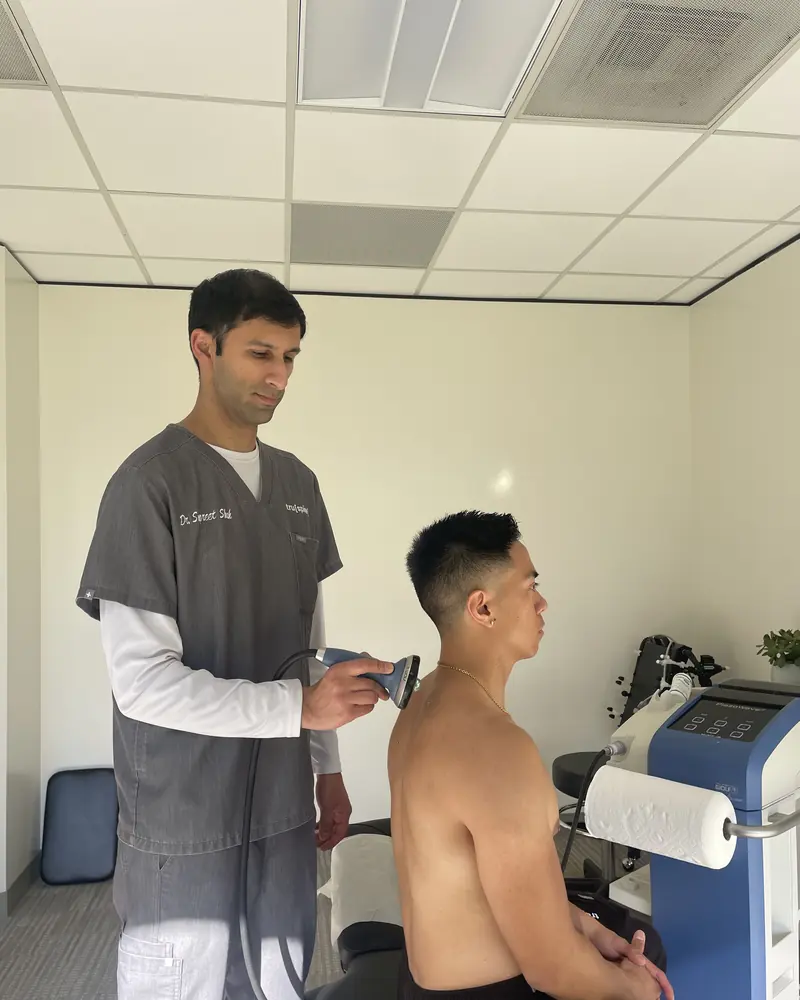
Focused shockwave therapy at our North Beach clinic.
The research
Research supports therapeutic ultrasound as part of a treatment plan, with the strongest results for knee pain and some shoulder and wrist conditions.
That is why we never use it on its own. We pair it with adjustments, soft tissue work and exercise, and move to shockwave when a tendon needs a stronger push.
Safety
Yes. It is non-invasive, painless and has no downtime when done by a trained provider.
We do not use it over the abdomen during pregnancy, over the eyes, over a pacemaker, over cancer or an active infection, over a blood clot, or over growing bones in children.
Questions?
Send us a message and our team will get back to you, or call (415) 421-1115.
Straight answers from our San Francisco clinic.
Ultrasound therapy, also called therapeutic ultrasound, uses high-frequency sound waves delivered through a small handheld wand to gently warm and stimulate muscles, tendons and ligaments below the skin. It increases blood flow, relaxes tight muscles and supports soft tissue healing. It is a common treatment in physical therapy and chiropractic clinics.
No. An ultrasound scan (diagnostic ultrasound) creates pictures of the inside of the body, like a pregnancy scan. Therapeutic ultrasound does not take pictures. It uses sound waves to treat sore, tight or injured soft tissue. TruSpine does not offer imaging scans.
TruSpine offers therapeutic ultrasound at 50 Francisco Street, Suite 257, in North Beach / North Waterfront, near Fisherman's Wharf, Russian Hill, Telegraph Hill, the Marina and the Financial District. Book online or call (415) 421-1115.
"Ultrasound massage" is a common name for therapeutic ultrasound. The wand glides over the skin with gel, which can feel like a gentle massage, but the benefit comes from the sound waves working in the tissue underneath.
The wand sends sound waves into the tissue. In continuous mode they create gentle deep heat that relaxes muscles and makes tight tissue more flexible. In pulsed mode they create tiny vibrations without much heat, which supports healing in newer injuries. We choose the frequency to reach either deeper or more surface tissue.
We use it for muscle strains and spasms, tendonitis, bursitis, stiff joints, scar tissue, sprains, and low back, neck, shoulder and knee pain, usually alongside chiropractic care and exercise.
Research supports therapeutic ultrasound as part of a treatment plan, with the strongest results for knee pain and some shoulder and wrist conditions. It works best combined with hands-on care and exercise, which is how we use it.
They do different jobs. Ultrasound is gentle and great for warming and relaxing soft tissue. Shockwave therapy delivers much stronger acoustic pulses that trigger the body's healing response, and it is our first choice for stubborn tendon problems such as plantar fasciitis, tennis elbow, Achilles pain and calcific shoulder tendinitis. Many patients who start with ultrasound move on to shockwave for faster, longer-lasting relief.
No. Most people feel nothing at all or a gentle warmth. Let us know if it ever feels hot or uncomfortable and we will adjust it.
Treatment usually takes about 5 to 10 minutes per area, and it is often done during your chiropractic visit.
It depends on the problem and how long you have had it. After your exam we recommend a plan, check your progress and let you know if shockwave or another treatment would get you better results.
Yes. The deep heat helps tight scar tissue become more flexible so it stretches and moves more easily. For stubborn scar tissue we often pair it with the Graston Technique.
It can ease the muscle spasm and tightness around an irritated disc, but it does not treat the disc itself. For disc pain and sciatica we usually recommend spinal decompression therapy.
Ultrasound is usually part of your treatment visit rather than a separate service. We work with many in-network and out-of-network insurance plans, and our team can check your benefits before your visit.
Home ultrasound devices exist, but they are lower powered and easy to use incorrectly. In the clinic we choose the right settings for your tissue and combine ultrasound with treatments that make it work better.
It is not used over the abdomen during pregnancy, over the eyes, over a pacemaker, over cancer or an active infection, over a blood clot, or over growing bones in children. Tell us your full health history so we can confirm it is safe for you.
Book a visit at our North Beach clinic. We will find the source of your pain and tell you whether ultrasound, shockwave or another treatment will get you the best results.
Individual results vary. An exam is required to confirm ultrasound therapy is right for you. TruSpine provides therapeutic ultrasound only and does not offer diagnostic imaging. This page is for informational purposes and is not medical advice.