
The following at home sciatica stretches are the most recommended for symptomatic people. Stretching is important for any person’s overall good health. However, for people with moderate or severe sciatica nerve pain, we recommend an SF chiropractor’s assessment first.
Sciatica specialist Supreet Shah says that sciatica pain can occur for a variety of reasons. He states, “Identifying what doesn’t move is the first step toward solving the problem.” Often, the most problematic body parts are the lower back and hips.
1. Figure-4 Stretch
Figure-4 stretch is a common yoga pose. It works to open the hips. There are multiple versions of this stretch. The first is a starting version known as the reclining figure-4 stretch. If you are just starting your treatment, you should try the reclining pose first.
- While on your back, bring your right leg up to a right angle. Clasp both hands behind the thigh, locking your fingers.
- Lift your left leg and place your right ankle on top of the left knee.
- Hold the position for 1 minute. This helps stretch the tiny piriformis muscle, which sometimes becomes inflamed and presses against the sciatic nerve, causing pain.
- Repeat on the opposite side
Once you can do the reclining version without pain, work with your chiropractor on the advanced versions of this sciatica stretch.

2. Forward Pigeon Pose
- Kneel on the floor on all fours.
- Pick up your right leg and move it forward on the ground in front of your body. Your lower leg should be on the ground, horizontal to the body. Your right foot should be in front of your right knee while your right knee stays to the right.
- Stretch the left leg out all the way behind you on the floor, with the top of the foot on the ground and toes pointing back.
- Shift your body weight gradually from your arms to your legs so that your legs are supporting your weight. Sit up straight with your hands on either side of your legs.
- Take a deep breath. While exhaling, lean your upper body forward over your front leg. Support your weight with your arms as much as possible.
- Repeat on the opposite side for a balanced sciatica stretch.

3. Seated Spinal Stretch
Sciatica nerve pain is triggered when vertebrae in the spine compress. This sciatica stretch helps create space in the spine to relieve pressure on the sciatic nerve.
- Sit on the ground with your legs extended straight out with your feet flexed upward.
- Bend your right knee and place your foot flat on the floor on the outside of your opposite knee.
- Place your left elbow on the outside of your right knee to help you gently turn your body toward the right.
- Hold for 1 minute and repeat three times, then switch sides.

4. Standing Hamstring Stretch
This sciatica stretch can help ease pain and tightness in the hamstring caused by the nerve.
- Place your right foot on an elevated surface at or below your hip level. This could be a chair, a bench, or a step on a staircase. Flex your foot so your toes and leg are straight. If your knee tends to hyperextend, keep a slight bend in it.
- Bend your body forward slightly toward your foot. The further you go, the deeper the stretch. Do not push to the point of pain.
- Release the hip of your raised leg downward as opposed to lifting it up. For extra support with easing your hip down, loop a yoga strap or long exercise band over your right thigh and under your left foot.
- Hold for at least 1 minute, and then repeat on the other side.

5. Knee to Opposite Shoulder
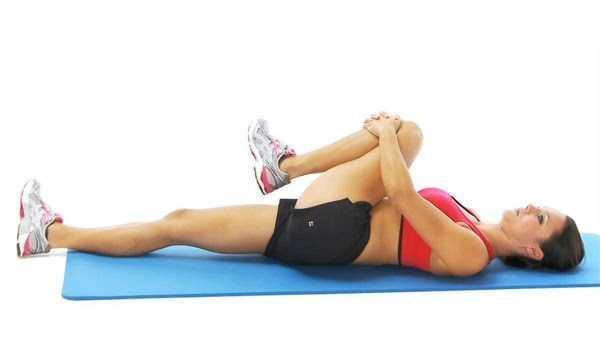
This simple self-care stretch helps relieve sciatica pain by loosening your gluteal and piriformis muscles, which can become inflamed and press against the sciatic nerve.
- Lie on your back with your legs extended and your feet flexed upward.
- Bend your right leg and clasp your hands around the knee.
- Gently pull your right leg across your body toward your left shoulder. Hold it there for 1 minute. Remember to pull your knee only as far as it will comfortably go. You should feel a relieving stretch in your muscle, not pain.
- Push your knee so your leg returns to its starting position.
- Repeat for a total of 4 reps, and then switch legs.
These at-home sciatica stretches have helped our patients greatly. If you are still having trouble finding sciatic nerve pain relief, you may be a good candidate for our treatments. To get to the root cause of pain and discomfort, schedule an initial consultation, including a comprehensive evaluation and first treatment.
There’s more to learn and explore:
Why Sitting Makes Sciatica Worse
Most of the people we treat for sciatica in San Francisco sit for a living. That is not a coincidence. Sitting raises the pressure inside your lumbar discs compared with standing, and most of us sit with the low back rounded, which pushes disc material backward toward the nerve root that is already irritated. Hold that position for eight hours and the hip flexors shorten while the glutes stop firing, so the mechanics are worse when you stand up than they were when you sat down.
The fix is not to stop sitting. It is to stop sitting still. Standing up every thirty to forty five minutes, even briefly, does more than an expensive chair will. Set your seat so your hips are slightly above your knees, keep your feet flat, and put the lumbar support where your belt line is rather than up in the mid back. Then use the stretches above during those breaks rather than saving them all for the evening.
If the leg pain is the dominant symptom and it is not settling, that usually points to a disc pressing on the nerve root rather than muscle tightness. Our sciatica treatment page covers what we do about that, and spinal decompression is often the tool for it.
Common Questions About Sciatica Stretches
How often should I do these sciatica stretches?
Most people do best with a short session once or twice a day rather than one long session. Consistency matters far more than intensity here. If you sit for work, breaking the day up with one or two of these every couple of hours will do more for you than a single long stretch in the evening.
Should these stretches hurt?
You should feel a stretch, not pain. A mild pulling sensation in the glute or the back of the thigh is what you are after. Sharp pain, or pain that shoots further down the leg than it did before you started, means stop. Pain that travels further down the limb during a movement is a sign the nerve is being provoked rather than freed.
Which one should I start with if my leg pain is bad?
Start with the knee to opposite shoulder and the figure 4, both done lying on your back. They load the spine the least. Leave the standing hamstring stretch and the forward pigeon until the leg symptoms have settled, because both put more tension through the nerve.
Why does sitting make my sciatica worse?
Sitting raises pressure inside the lumbar discs compared with standing, and most people sit with the low back rounded, which pushes disc material toward the nerve root. On top of that the hip flexors shorten and the glutes switch off, so when you do stand up the mechanics are worse than when you sat down. It is the sustained position that does the damage, not sitting itself.
When should I stop stretching and see someone?
If symptoms are getting worse rather than better over two weeks, if you develop weakness in the foot or leg, or if the pain wakes you at night. Seek emergency care immediately for loss of bladder or bowel control or numbness through the groin and inner thighs, which are signs of a surgical emergency rather than ordinary sciatica.