Quick answer
What kind of doctor treats knee pain?
Several kinds of doctors treat knee pain, and the right first stop depends on how it started. For pain that built up gradually (runner’s knee, tendon pain, stiffness or an arthritis flare), start with conservative care from a chiropractor who treats knees, a physical therapist or a sports medicine physician. For a sudden injury with a pop, fast swelling, locking or a knee that gives way, see an orthopedist or sports medicine doctor first.
Go to urgent care or the ER if you cannot put weight on the leg, the knee looks deformed, or it is hot, red and swollen with a fever.
Your options
Knee pain doctors compared
A “knee pain doctor” is not one specialty. These are the providers people see most often, what each one is best for, and when to choose them.
Orthopedist (orthopedic surgeon)
Best for: Acute injuries, suspected ligament or meniscus tears, advanced arthritis.
What they do: Diagnoses structural damage with imaging, gives injections and performs surgery such as arthroscopy or knee replacement.
Choose first after a significant injury.
Chiropractor who treats knees
Best for: Gradual pain, overuse, tracking problems, tendon pain and arthritis stiffness.
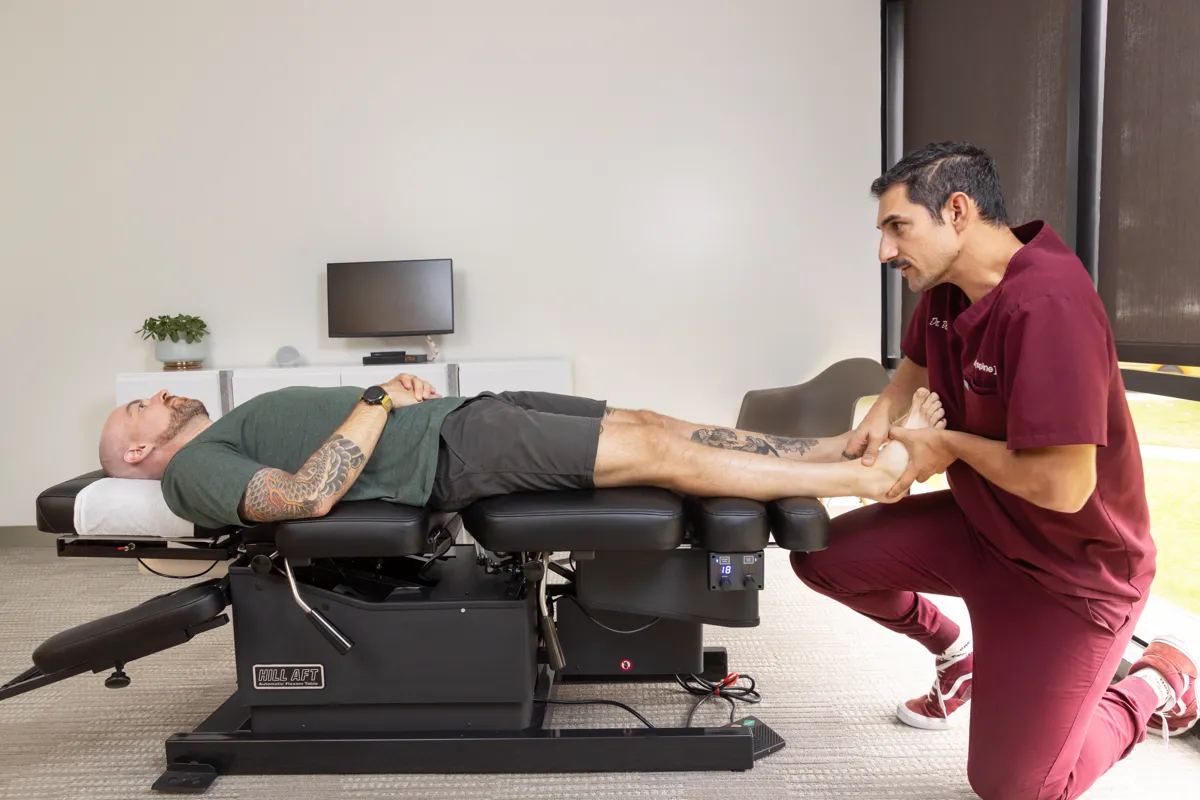
What they do: Examines the whole leg, then treats with hands-on care, Knee on Trac, shockwave, Graston and exercise. Refers out when imaging is needed.
Choose first for most non-emergency knee pain.
Sports medicine physician
Best for: Active people and athletes with injuries or overuse pain.
What they do: Non-surgical medical diagnosis, imaging, injections and return-to-sport guidance.
Good first stop for sports injuries.
Physical therapist
Best for: Rehab after injury or surgery, strength and movement problems.
What they do: Builds strength, mobility and control through guided exercise programs.
Often part of the plan, before or after other care.
Primary care physician
Best for: A first opinion when you are unsure, or pain with other health issues.
What they do: Initial exam, basic imaging and blood work, and referral to a specialist.
Good if you also feel unwell.
Rheumatologist
Best for: Several swollen joints, morning stiffness, suspected gout or rheumatoid arthritis.
What they do: Diagnoses and manages inflammatory and autoimmune joint disease.
Choose when more than one joint is involved.
Pain management physician
Best for: Long-standing pain that has not responded to other care.
What they do: Injections, nerve blocks and medication management.
Usually after conservative care.
Acupuncturist
Best for: Pain relief alongside other care, including arthritis pain.
What they do: Uses fine needles to reduce pain and muscle tension.
A helpful add-on to a treatment plan.
Who to see first
Match your symptoms to the right provider
- You felt a pop, the knee swelled within hours, or it locks or gives wayOrthopedist or sports medicineThese are signs of a possible ligament or meniscus tear that may need an MRI.
- Pain at the front of the knee on stairs, squats or after sittingChiropractor or physical therapistOften patellofemoral pain from how the kneecap tracks. It usually responds well to conservative care.
- Pain on the outside of the knee when you run or cycleChiropractor or physical therapistCommonly IT band irritation linked to hip strength and training load.
- Stiff, achy knees that are worse in the morning or after activityChiropractor, then orthopedist if neededTypical of osteoarthritis. Conservative care and Knee on Trac knee decompression can help, and we refer for injections or a surgical opinion when needed.
- A hot, red, swollen knee, especially with a feverUrgent care or the ER the same dayThis can be an infection or gout and needs medical care straight away.
- Several joints are swollen at oncePrimary care or rheumatologistThis points to an inflammatory or autoimmune cause.
Causes
What causes knee pain?
Knowing the likely cause helps you pick the right provider. These are the causes we see most often in San Francisco patients, from runners and cyclists to people who simply walk the hills every day.
Injuries
Ligament sprains such as the ACL or MCL, meniscus tears and kneecap problems from twisting, falls or sport. Read more
Osteoarthritis
Gradual wear of the joint cartilage that causes stiffness, aching and swelling, especially after activity. Read more
Overuse
Runner’s knee, patellar tendon pain and IT band syndrome from repeated load without enough recovery. Read more
Muscle imbalances
Weak hips and glutes or tight quads and calves change how the kneecap tracks and how force moves through the joint.
Foot and hip mechanics
Flat feet, stiff ankles or hip problems shift stress onto the knee. Orthotics and mobility work can help. Read more
Body weight
Extra weight multiplies the load on the knee with every step and speeds up arthritis.
Inner knee pain
Pain on the inside of the knee often involves the MCL, meniscus or pes anserine bursa. Read more
Aging
Cartilage and tendons lose resilience over time, but staying strong and active keeps most knees working well.
Want more detail? Read common knee pain causes or why does my knee hurt?
Timing
How long should knee pain last before you see a doctor?
Minor strains often improve within one to two weeks with rest, ice and easier activity. Book a knee exam if:
- Pain lasts longer than two weeks or keeps coming back
- Stairs, squatting, kneeling or walking downhill hurt
- The knee feels unstable, clicks painfully or catches
- Pain wakes you at night or limits exercise you enjoy
- You have stopped activities because of your knee
Get same-day medical care if you notice:
- You cannot put weight on the leg after an injury
- The knee looks deformed or the kneecap has shifted
- Rapid, large swelling
- A hot, red, swollen knee with fever or chills
- Calf pain and swelling with the knee pain
Normal scans, real pain
“My doctor says nothing is wrong, but my knee still hurts”
We hear this often. X-rays and MRIs show bone and structure, but they can miss the problems that cause a lot of knee pain: irritated tendons and soft tissue, a kneecap that tracks poorly, weak hip muscles, or a stiff ankle that forces the knee to take extra load.
A normal scan is good news. It usually means the problem is mechanical, and mechanical problems tend to respond well to conservative care. A hands-on movement exam is how we find them.
How we help
How TruSpine treats knee pain
Our chiropractor-led team looks at the whole leg, not just the sore spot, then builds a plan from the therapies below. If your exam suggests a tear or anything outside our scope, we tell you and refer you to the right specialist.
Knee on Trac
Gentle knee decompression that opens the joint space to ease pressure and stiffness, especially in arthritic knees.
Learn about knee decompression →Shockwave therapy
Acoustic pulses that stimulate repair in stubborn tendon and soft tissue pain around the knee.
Shockwave therapy →Graston technique
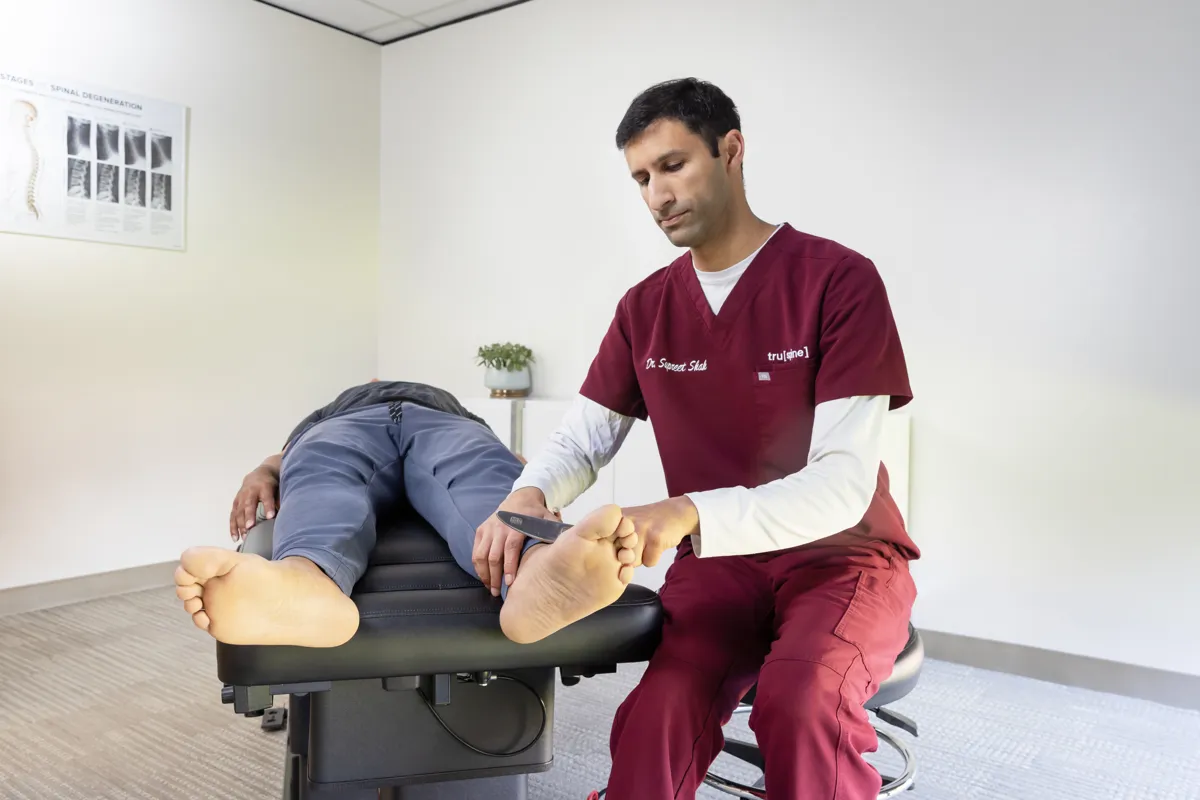
Instrument-assisted soft tissue work for the quads, IT band, hamstrings and calf.
Graston for knees →Chiropractic care
Hands-on care for the knee, hip, ankle and foot to restore how the whole leg moves.
Chiropractic adjustments →Acupuncture
Fine-needle treatment for pain and muscle tension, offered at our 150 Lombard Street office.
Acupuncture →Laser and ultrasound therapy
Therapeutic modalities that support healing and ease pain in irritated tissue.
Laser therapy →Rehab exercises
A home program for hip, thigh and calf strength so results last between visits.
Why does my knee hurt →Weight and nutrition support
Medical weight loss and nutrition guidance to take load off painful knees.
Medical weight loss →Free download
Get our Knee on Trac guide
Learn which knee conditions Knee on Trac is used for, how sessions work, its benefits and who it is not right for. Fill out the form and we will send the guide to you.

Your first visit
What to expect at your knee pain visit
- 1
Book online or call
Pick a time online or call (415) 421-1115. Intake forms are sent to you after booking.
- 2
History and exam
We ask how the pain started and test how your knee, hip, ankle and foot move and handle load. Your first visit takes about 30 to 40 minutes.
- 3
A clear explanation
We tell you what we found, whether you need imaging or a referral, and what we recommend.
- 4
Start your plan
When it is appropriate, treatment can begin the same day, along with exercises to do at home.
Near you
Finding a knee pain specialist near you in San Francisco
Look for a provider who examines the whole leg, explains what they find in plain language, offers more than one treatment option and refers out when needed. TruSpine treats knee pain at our North Beach office near Fisherman’s Wharf, Russian Hill, the Marina and Telegraph Hill.
50 Francisco St, Suite 257, San Francisco, CA 94133
Mon–Fri, 8am–6pm
We work with many in-network and out-of-network insurance plans. No referral is needed.
FAQs
Knee pain doctor FAQs
What kind of doctor should I see for knee pain?
It depends on how the pain started. For a sudden injury with a pop, fast swelling, locking or a knee that gives way, see an orthopedist or sports medicine physician first. For pain that built up gradually, such as runner’s knee, tendon pain or an arthritis flare, a conservative-care provider like a chiropractor who treats knees, a physical therapist or a sports medicine doctor is a sensible first stop. If you are unsure, a knee exam will tell you which path fits, and we refer out when imaging or a specialist is needed.
Is an orthopedist or a chiropractor better for knee pain?
They do different jobs. An orthopedist diagnoses structural damage, orders imaging, gives injections and performs surgery when it is needed. A chiropractor who treats knees focuses on non-surgical care: joint mobility, soft tissue, the hip, ankle and foot mechanics that load the knee, and in-office therapies such as Knee on Trac, shockwave and Graston. Many people start with conservative care and see an orthopedist if the exam points to a tear or the knee is not progressing.
Can a chiropractor help with knee pain?
Yes. Chiropractors trained in extremity care treat many common knee problems, including patellofemoral pain, tendon pain, IT band irritation and arthritis-related stiffness. At TruSpine that care combines hands-on treatment with Knee on Trac, shockwave therapy, Graston technique and a home exercise plan. See why your knee hurts for the causes behind it.
How long should knee pain last before I see a doctor?
Minor strains often settle within one to two weeks with rest, ice and easier activity. Book an exam if pain lasts more than two weeks, keeps coming back, wakes you at night, or makes stairs, squatting or walking hard. Seek care the same day for major swelling, a knee you cannot put weight on, a visible deformity, or a hot, red, swollen joint with a fever.
What are the most common causes of knee pain?
Injuries such as ligament sprains and meniscus tears, osteoarthritis, overuse problems like runner’s knee, patellar tendon pain and IT band syndrome, muscle imbalances around the hip and thigh, extra body weight, and alignment issues in the foot or hip that change how force travels through the knee.
What is Knee on Trac?
Knee on Trac is a knee decompression device. It gently opens the space inside the knee joint while you rest, which can ease pressure and stiffness in arthritic and overloaded knees. At TruSpine it is used as part of a broader plan with hands-on care and exercise rather than on its own. You can download our free Knee on Trac guide on this page.
How does shockwave therapy help knee pain?
Shockwave therapy delivers acoustic pulses into irritated tendons and soft tissue. It is used for stubborn tendon problems around the knee, such as patellar tendinopathy and IT band irritation, to stimulate the body’s repair response. It is non-invasive and sessions are short. Learn more about shockwave therapy.
What is the Graston technique and is it used for knees?
Graston is an instrument-assisted soft tissue technique that uses stainless steel tools to work through restricted muscle and fascia. Around the knee it is used for the quadriceps, IT band, hamstrings and calf. Read Graston technique for knee pain.
Can a chiropractor help with knee arthritis?
Chiropractic care cannot reverse arthritis, but it can help many people move more comfortably. Treatment focuses on joint mobility, strength around the knee and hip, and therapies such as Knee on Trac that ease joint pressure. If your knee needs injections or a surgical opinion, we will tell you and refer you. More on osteoarthritis of the knee.
My doctor says nothing is wrong, but my knee still hurts. What now?
A normal X-ray or MRI does not mean the pain is imaginary. Imaging shows bone and structure, but it often misses movement problems, soft tissue irritation and stress coming from the hip, ankle or foot. A hands-on movement exam can find those, and they usually respond to conservative care.
Does extra weight cause knee pain?
It can. Each extra pound adds several pounds of load across the knee with every step, which speeds up wear in arthritic knees. Even modest weight loss reduces that load. TruSpine also offers medical weight loss for patients who want support with that side of knee health.
Are there natural treatments for knee pain?
Yes. Non-surgical options include targeted strengthening, mobility work, chiropractic care, acupuncture, shockwave therapy, soft tissue work, supportive footwear or custom orthotics, and weight management. Most people do best with a combination rather than one treatment.
Can knee pain be reversed or is it permanent?
Most knee pain from overuse, muscle imbalance and soft tissue irritation improves with the right care. Arthritis changes in the joint do not reverse, but symptoms often become much more manageable. Pain from a significant tear may need a surgical opinion. Your exam will show which group you are in.
What happens at a first visit for knee pain at TruSpine?
Your first chiropractic visit takes about 30 to 40 minutes. We go over your history, test how your knee, hip, ankle and foot move and load, and check for anything that needs imaging or a referral. Then we explain what we found and recommend a plan. When it is appropriate, treatment can start the same day.
Is chiropractic treatment safe for knee pain?
For most people, yes. Care for the knee is gentle and is adapted to your age, activity level and any arthritis. If your exam shows signs of a serious tear, fracture, infection or a problem outside our scope, we refer you to the right specialist instead of treating it.
Do I need a referral to see a chiropractor for knee pain?
No. You can book directly online or by calling (415) 421-1115. We work with many in-network and out-of-network insurance plans, and our team can help you check your benefits before your visit.
How do I find a good knee pain specialist near me in San Francisco?
Look for a provider who examines the whole leg rather than only the knee, explains what they find, offers more than one treatment option, and refers out when imaging or surgery needs to be considered. Reviews from patients with similar problems are useful too. TruSpine is at 50 Francisco Street in North Beach, with a 5.0 rating from 272 Google reviews.
Can muscle imbalances cause knee pain?
Yes, and it is one of the most common causes we see. Weak hip and glute muscles, tight quadriceps or IT band, and poor ankle mobility change how the kneecap tracks and how force passes through the joint. Fixing those imbalances is often what keeps knee pain from coming back.
Keep reading
Related knee pain resources
Medically reviewed by Dr. Supreet Shah, DC, MS, CCSP, chiropractor and founder of TruSpine San Francisco.
This article is for general information and is not medical advice. Individual results vary. If you have a knee injury or new symptoms, get a professional evaluation.